
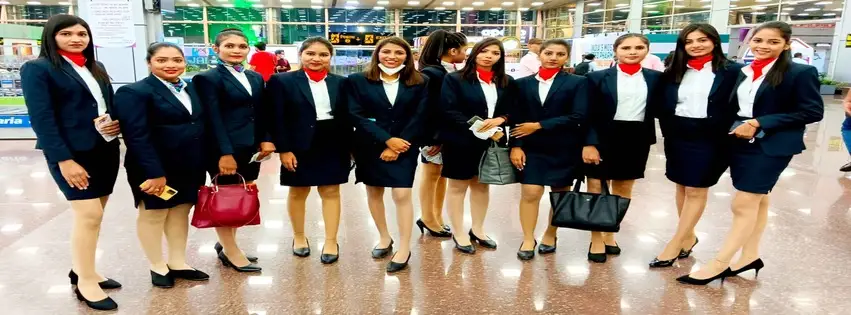
Unnati Air Hostess Training Institute is a vocational aviation training institute in Jhotwara, Jaipur. Its training focuses on cabin crew, ground staff and related aviation careers, with strong emphasis on spoken English, grooming, personality development and interview preparation. The institute also offers longer aviation and hospitality programmes, including diploma and B.Voc options.
For students considering Unnati, the main question is not simply whether it offers air hostess training. The more useful question is whether its course structure, practical exposure, location and career support match what you actually need.
This guide brings those factors together, including the information that is less clear from public sources.
Unnati Air Hostess Training Institute Jaipur at a Glance
| Particular | Details |
|---|---|
| Institute | Unnati Air Hostess Training Institute |
| Location | 3A, Main Dadi Ka Phatak Underpass, Benad Road, Jhotwara, Jaipur, Rajasthan 302012 |
| Main areas | Cabin crew, air hostess, flight steward and ground staff training |
| Key training | Aviation, grooming, spoken English, hospitality, personality development and interviews |
| Practical exposure | In-flight training, airport visits, swimming sessions and cabin crew seminars |
| Eligibility | 12th pass; institute lists age 17–25 |
| Contact | +91 9783327982 / +91 7737350508 |
Courses at Unnati Air Hostess Training Institute Jaipur
Unnati Air Hostess Training Institute offers aviation-focused programmes ranging from a one-year cabin crew diploma to a three-year B.Voc programme. The courses differ in their depth and career focus, so students should choose based on whether they want short-term cabin crew preparation or a broader aviation and hospitality qualification.
Diploma in Cabin Crew, Hospitality & Tourism Management
This programme is designed mainly for students interested in cabin crew and related customer-facing aviation roles. Training covers aviation basics, passenger handling, safety procedures, hospitality, grooming, spoken English and personality development. Students also receive interview preparation through mock interviews, group discussions and role-play. Practical activities include airport visits, in-flight training and swimming sessions.
Eligibility
- Age: 17–25 years
- Education: Class 12 pass, any stream
- Height: 155 cm for females and 172 cm for males
- BMI: As per industry standards
- Other requirements: The training also focuses on communication, grooming, personality and professional presentation.
Duration: 1 year
Class Duration: 4 hours per day
Fees: ₹60,000 – ₹85,000
Diploma in Aviation, Hospitality & Tourism Management
This is a broader programme covering aviation, hospitality and tourism rather than focusing only on cabin crew preparation. It can suit students who want exposure to several customer-service and aviation-related career areas. The programme combines vocational training with subjects related to aviation and hospitality operations.
Eligibility
The publicly available course information does not provide a separate, course-specific set of age, height and BMI requirements for this diploma. The air-hostess programme lists its own eligibility criteria, but those requirements should not automatically be treated as requirements for this broader diploma.
Duration: 1 year 3 months
Class Duration: 4 hours per day
Fees: ₹80,000 – ₹1,10,000
B.Voc in Aviation, Hospitality & Tourism Management
The B.Voc programme provides a longer academic and vocational route in aviation, hospitality and tourism. Unlike the shorter diploma programmes, it is structured as a three-year programme. It may be more suitable for students looking for a longer qualification rather than a short-term cabin crew training course.
Eligibility
A separate course-specific age, height and BMI requirement is not clearly published in the available public information. The cabin crew course’s physical eligibility criteria should therefore not be presented as the admission criteria for this B.Voc programme.
Duration: 3 years
Class Duration: 4 hours per day
Fees: ₹1,50,000 – ₹2,20,000
Which Unnati course should you choose?
The Diploma in Cabin Crew, Hospitality & Tourism Management is the most directly relevant option if your goal is cabin crew training.
The Diploma in Aviation, Hospitality & Tourism Management is broader and may suit students interested in aviation, hospitality and tourism rather than only cabin crew roles.
The B.Voc in Aviation, Hospitality & Tourism Management is the longest option and should be considered by students looking for a degree-level vocational pathway.
Before enrolling, the most important points to confirm are the current fee, exact admission requirements and the qualification awarded, particularly for the B.Voc programme. The publicly available information does not provide enough detail to state these confidently.
You May Like to Read:
What Does the Air Hostess Training Cover?
Unnati’s air hostess training goes beyond grooming and interview preparation. The programme combines aviation knowledge, cabin crew duties, passenger handling, communication, hospitality and practical preparation for airline recruitment.
The main areas of training include:
Aviation and cabin crew fundamentals
Students are introduced to the aviation industry, aircraft interiors and exteriors, cabin crew responsibilities, crew coordination and aviation geography. The training also covers documentation and the basic working environment of an airline.
Safety and security
Safety is an important part of cabin crew preparation. Training covers safety and emergency procedures, airport and in-flight security, ground security and the responsibilities of cabin crew during different situations.
Passenger handling and hospitality
The course develops skills needed for dealing with passengers professionally. This includes passenger handling, customer service, hospitality and basic food and beverage service.
These skills are relevant because cabin crew work involves much more than serving passengers. Crew members also have to communicate clearly, manage different passenger needs and maintain professional behaviour during a flight.
Grooming and personality development
Training includes professional grooming, personal hygiene, posture and personality development. The aim is to help students develop the appearance, confidence and professional manner expected in customer-facing aviation roles.
English and communication skills
Spoken English, public speaking, group discussions and role-play form part of the communication training. These activities can be particularly useful for students who are academically eligible but need more confidence when speaking or interacting with others.
Interview and recruitment preparation
The programme also covers resume preparation, mock interviews, telephonic interview techniques and group discussions. This gives students an opportunity to practise the type of communication and presentation skills commonly required during entry-level recruitment.
Practical exposure
The training also includes activities such as in-flight training, airport visits, swimming sessions and cabin crew seminars. These activities add practical exposure to the classroom-based learning.
What this training can and cannot do
The course can help students build aviation knowledge, communication skills, grooming, confidence and interview readiness. It does not, by itself, guarantee selection by an airline.
Actual cabin crew recruitment depends on the candidate’s eligibility, communication ability, interview performance, medical fitness and the hiring requirements of the airline.
For a student comparing aviation institutes, the more useful question is therefore not simply how many subjects a course lists. It is whether the training provides enough practical exposure, communication practice and recruitment preparation to help build job-ready skills.
Practical Training at Unnati
Practical exposure is an important part of Unnati’s air hostess training. The programme combines classroom learning with activities designed to help students practise communication, confidence and cabin crew-related skills.
What practical exposure includes
In-flight training: Students get exposure to a simulated or training-based flight environment, helping them understand cabin procedures and passenger interaction.
Airport visits: Visits provide an opportunity to see the airport environment and understand how different aviation operations work beyond the classroom.
Swimming sessions: Swimming is included as part of the training. This is relevant to cabin crew preparation because water-related safety can form part of aviation training.
Cabin crew seminars: Interaction through seminars gives students exposure to industry-related discussions and career guidance.
Group discussions and presentations: These activities help students practise speaking, expressing ideas and communicating in front of others.
Stage exposure and role-based activities: These can help students become more comfortable with public interaction, presentation and professional communication.
Mock interviews: Interview practice helps students work on answers, confidence, body language and overall presentation before facing recruitment interviews.
Why this practical exposure matters
For a cabin crew aspirant, practical training is useful when it turns classroom concepts into situations that can be practised.
A student may understand passenger handling in theory but still struggle to communicate confidently in a role-play. Similarly, knowing interview questions is different from answering them under pressure.
Activities such as presentations, group discussions, mock interviews and simulated cabin training can help bridge that gap.
However, there is an important distinction between training exposure and airline work experience. Airport visits, seminars, simulations and mock interviews help students prepare for the industry, but they do not amount to employment with an airline or operational experience as a cabin crew member.
For a student comparing training institutes, the key question is therefore not simply whether practical activities are offered. It is how regularly students participate, how closely the activities relate to cabin crew work and how much individual practice they receive.
Admission Process at Unnati
The admission process is relatively straightforward for students interested in joining Unnati’s air hostess training programmes.
1. Choose the course
Students can select the programme that best matches their career goal, such as the Diploma in Cabin Crew, Hospitality & Tourism Management or the B.Voc in Aviation, Hospitality & Tourism Management.
2. Check eligibility
Before applying, students should confirm that they meet the eligibility requirements for the selected programme. The air hostess course information specifies 12th-pass education, along with age, height and BMI requirements.
3. Contact the institute
Students can contact Unnati directly to enquire about the current batch, admission requirements, fees and available seats.
4. Submit the required documents
Applicants may need to provide their educational and identification documents during the admission process. The exact document list should be confirmed with the institute before submitting an application.
5. Complete the admission formalities
Once the course, eligibility and fee details are confirmed, the student can complete the institute’s admission formalities and secure a place in the selected programme.
Before paying the admission fee: Ask for the current fee structure, refund policy, course certificate or awarding body, batch schedule and the exact eligibility criteria for the programme you are joining. This is especially important because eligibility can differ between an air-hostess-focused programme and broader aviation or B.Voc courses.
Placement support: what can actually be established?
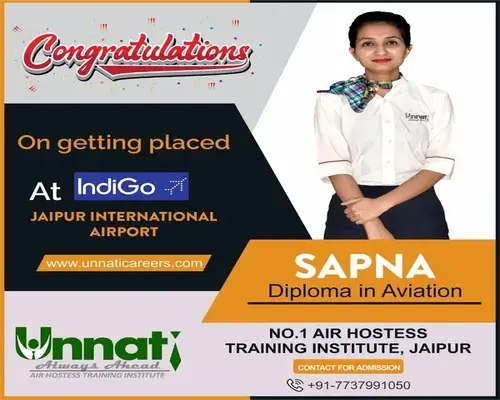
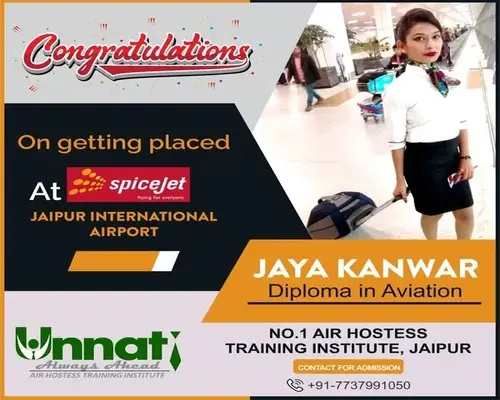
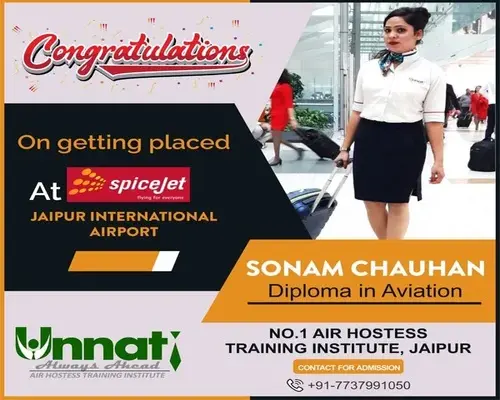
Unnati promotes placement support as part of its aviation training. Its website also displays student placement-related material and testimonials, including a testimonial from a student who says she is flying with SpiceJet.
That provides evidence that placement support is part of the institute’s offering and that individual students report successful outcomes.
It does not, by itself, establish a placement percentage for the institute.
There is not enough publicly documented information to independently assess the number of students placed, the proportion of the graduating batch placed, average salaries or the time taken to secure employment.
This is an important distinction when comparing aviation institutes. “Placement assistance” means support with recruitment, interviews or career preparation. It is not the same as a guaranteed airline job.
Reviews and student experience
Public reviews are generally positive.
A current Justdial review page shows a 4.8 rating based on 165 ratings. Reviews repeatedly mention communication skills, English, grooming, confidence, teaching and supportive trainers.
Some older reviews also describe individual attention and personality development.
There is, however, at least one negative review mentioning inadequate security. A single review should not be treated as proof of a systemic problem, but it is worth recognising that public feedback is not uniformly positive.
The strongest recurring pattern in the available reviews is around communication, confidence, grooming and teacher support.
The reviews are less useful for establishing objective outcomes such as placement rates or salaries. Ratings can indicate student satisfaction, but they cannot prove teaching quality or employment success on their own.
What stands out about Unnati?
Unnati has a few characteristics that may make it relevant to a particular type of student.
A strong focus on communication
Spoken English, public speaking, group discussions and interview preparation receive substantial attention.
This can be useful for students who are academically eligible but lack confidence or professional communication skills.
Practical exposure is built into the course
Airport visits, swimming, in-flight training and cabin crew seminars give the programme a practical element.
The value of these activities will depend on how frequently they are conducted and how much hands-on participation each student receives.
The course is broader than cabin crew grooming
Students also study aviation operations, hospitality, customer service and tourism.
That gives the programme some relevance to ground staff and other customer-facing aviation roles.
It is a Jaipur-based classroom option
For students who prefer studying locally instead of moving to Delhi or Mumbai, the Jhotwara location is a practical advantage.
What should students consider before joining?
The biggest issue is not a lack of information. It is the inconsistency and limited public detail around some important commercial and academic facts.
The course pages show different durations for similarly named diploma programmes. The fee is not publicly stated as a current figure. The placement material demonstrates support and individual success stories, but does not provide enough data to calculate an actual placement rate.
The B.Voc programme also deserves closer scrutiny because students should know the exact awarding institution and academic recognition attached to the qualification.
These are not necessarily reasons to reject the institute. They are reasons to compare the exact programme rather than choosing on the basis of a general “air hostess course” label.
Who may find Unnati suitable?
Unnati may be worth considering if you:
- Have completed or are completing Class 12
- Want cabin crew or ground staff training
- Need structured spoken-English practice
- Want grooming and personality-development training
- Prefer a classroom-based institute in Jaipur
- Want practical activities alongside classroom learning
- Are looking for a course that also covers hospitality and tourism
It may be less suitable if your priority is a fully degree-focused aviation education and you need extensive public information about the awarding university, academic structure and total fees before applying.
Students who are mainly interested in airline recruitment outcomes should also compare the quality of actual recruitment exposure rather than relying only on placement-support claims.
Alternatives worth comparing in Jaipur
Unnati should not be evaluated in isolation.
For students comparing cabin crew training in Jaipur, Frankfinn, Bloom and Fly Academy and Inferno Dreamz are among the other options worth examining.
Frankfinn has a much longer national operating history and identifies itself as an NSDC and Tourism & Hospitality Skill Council approved training partner.
Bloom and Fly is a newer Jaipur-based aviation academy with a strong focus on cabin crew training, practical exposure and recruitment activity. Its current public material documents campus recruitment activity and individual student placements, although its own placement claims should still be assessed on their terms and conditions.
The comparison should focus on factors such as course duration, total cost, trainer experience, practical exposure, recruitment opportunities, class size and the type of qualification awarded.
There is no single institute that is automatically the best choice for every student.
Final decision: Is Unnati Air Hostess Training Institute worth considering?
Unnati Air Hostess Training Institute is a genuine Jaipur-based classroom training option for students interested in cabin crew, ground staff and related aviation careers.
Its strongest publicly visible areas are communication training, grooming, personality development, interview preparation and practical aviation exposure. The course structure goes beyond appearance and includes aviation safety, passenger handling, hospitality and customer service.
The public student feedback is also broadly positive, particularly around confidence, English, grooming and trainer support.
The main areas requiring closer attention are the current fee, exact programme duration, qualification-awarding arrangement and measurable placement outcomes. Public information does not establish enough detail to judge placement performance by percentage or average salary.
That makes Unnati a reasonable institute to shortlist, but the right course depends on your objective.
If you want a practical Jaipur-based cabin crew course with strong communication and grooming preparation, Unnati is worth comparing. If you are choosing a longer academic qualification, examine the B.Voc structure and awarding body carefully before enrolling.
The best decision is therefore not based on the institute’s rating or the promise of an aviation career. It comes down to whether the specific course, training model, qualification and career support fit your goal.
Frequently Asked Questions
1. What courses does Unnati Air Hostess Training Institute offer?
Unnati currently lists three main aviation programmes: Diploma in Cabin Crew, Hospitality & Tourism Management, Diploma in Aviation, Hospitality & Tourism Management, and B.Voc in Aviation, Hospitality & Tourism Management.
The diploma programmes are listed as 1 year and 1 year 3 months respectively, while the B.Voc is a 3-year programme. The right choice depends on whether you want a shorter cabin crew-focused programme or a longer qualification covering aviation, hospitality and tourism.
2. What is the eligibility for air hostess training at Unnati?
The air hostess course information lists 12th pass in any stream as the educational requirement. It also specifies an age range of 17–25 years, along with height and BMI requirements for cabin crew applicants.
Students should confirm the eligibility for their specific programme before admission. The requirements for a cabin crew-focused course should not automatically be assumed to apply to every aviation or B.Voc programme.
3. What is the fee for air hostess training at Unnati Jaipur?
Diploma in Cabin Crew, Hospitality & Tourism Management: ₹60,000 – ₹85,000
Diploma in Aviation, Hospitality & Tourism Management: ₹80,000 – ₹1,10,000
B.Voc in Aviation, Hospitality & Tourism Management: ₹1,50,000 – ₹2,20,000
Students should ask for the complete fee structure in writing before paying. It is also worth confirming whether the quoted amount includes uniforms, study material, practical activities, examinations, certification and any other charges.
4. How long is the air hostess course at Unnati?
The Diploma in Cabin Crew, Hospitality & Tourism Management is listed as a 1-year programme. The Diploma in Aviation, Hospitality & Tourism Management is listed as 1 year and 3 months, while the B.Voc in Aviation, Hospitality & Tourism Management takes 3 years.
The longer B.Voc is therefore not simply a longer version of the same short-term cabin crew course. Students should compare the qualification, curriculum and awarding institution before choosing based only on duration.
5. Does Unnati provide practical training for cabin crew students?
Yes. Practical exposure highlighted by Unnati includes in-flight training, airport visits, swimming sessions, cabin crew seminars, group discussions, presentations, stage exposure and mock interviews.
These activities can help students practise communication, confidence, passenger interaction and interview skills. However, training activities should not be treated as equivalent to actual airline employment or cabin crew work experience.
6. Does Unnati guarantee placement in an airline?
Students should not interpret Unnati’s placement support as a guaranteed airline job.
The institute promotes placement assistance and displays student placement testimonials, including a testimonial from a student who says she is flying with SpiceJet. However, publicly available information does not establish a reliable placement percentage or guarantee that every student will be selected by an airline.
Before enrolling, ask specifically about placement assistance, interview opportunities, recruiter participation and actual student outcomes rather than relying only on a “placement” or “100% placement support” statement.
7. Is Unnati suitable for students who are not confident in English?
It can be useful for students who need to improve their communication before applying for cabin crew jobs. The training includes spoken English, public speaking, group discussions, presentations and confidence-building activities.
However, students should have realistic expectations. An institute can provide practice and guidance, but communication ability improves mainly through regular speaking and participation.
8. Is Unnati a good choice after 12th for becoming cabin crew?
It can be considered by a 12th-pass student who wants structured training in cabin crew skills, grooming, communication and interview preparation.
The more important question is whether the course matches the student’s requirements. Before joining, compare the course qualification, total fee, practical exposure, eligibility, placement support and certification with other Jaipur institutes.
A student should also check the recruitment requirements of the airlines they want to target rather than assuming that completing a training course guarantees eligibility or selection.
9. Is the Unnati air hostess course UGC approved?
Unnati’s website describes its programmes as “UGC Approved Courses.”
However, the publicly available information does not clearly establish the specific university or awarding institution behind each programme, particularly the B.Voc. Students should therefore ask for the name of the awarding university or institution, the nature of the qualification and the documents they will receive after completion.
This is an important point to clarify before paying admission fees, especially if the student wants the qualification for further education or employment beyond cabin crew training.
10. What should I check before taking admission at Unnati?
Do not make the decision only on the basis of the institute’s placement claims or promotional material. Before paying, ask for:
- The current course fee and complete fee breakup
- Eligibility for the exact course you are choosing
- Name of the awarding institution or university
- Certificate or qualification awarded after completion
- Current batch and admission details
- Practical training included in the fee
- Placement assistance and how recruitment opportunities are conducted
- Refund or cancellation policy
- Any additional charges during the course
A visit to the institute can also help you judge the classroom environment and understand how practical activities are actually conducted.
For a cabin crew aspirant, the best course is not necessarily the one with the biggest placement claim. It is the one that offers a suitable qualification, relevant practical training, realistic recruitment support and a cost that makes sense for your career plan.
Similar Institutes:


Rate us and Write a Review
- SundayDay Off
- Monday08:00 AM - 06:00 PM
- Tuesday08:00 AM - 06:00 PM
- Wednesday08:00 AM - 06:00 PM
- Thursday08:00 AM - 06:00 PM
- Friday08:00 AM - 06:00 PM
- Saturday08:00 AM - 06:00 PM

 Your request has been submitted successfully.
 Own or work here?